
06
Sep
Sync Your Workouts To Your Menstrual Cycle
Reading time - 16 mins
Ladies! Do you feel like you’re fighting your psychology and physiology sometimes? Could syncing your exercise with your menstrual cycle give you better results? Let’s find out.
You may already know a lot about your circadian rhythm, which regulates the sleep/wake cycle. Men’s hormones are guided by this, but for women, we are also governed by the infradian cycle. In terms of hormones, this is your menstrual cycle. The challenge is that most research done on optimising exercise and performance is based on studying males, and women are not the same as men!
Alisa Vitti (functional nutritionist) first created the ‘Cycle Syncing Method’, which is designed to flow with the nature of women’s hormones. Does science back this up? We don’t know, because there are not enough studies on it yet. In a 6-month trial, it was concluded that a diet and exercise program that’s tailored towards menstrual cycle changes can increase weight loss over a normal program. Without a ton of scientific data, it's wise not to make claims. However, scientific data can also be flawed, and the lack of ability to replicate results is a well-known problem. Your body is your best guide.
Working from common sense, you know that you have peaks and troughs in your natural energy levels throughout the month. You’ve probably had days you felt confusingly weak and tired, and other times where you're just bursting with energy and crushing it, even though you didn’t get more sleep or change anything in your diet. The ultimate guide is you and your very own body. By tuning in to yourself, observing what is happening and taking notes, you can start to work with it to optimise your health, vitality and body composition.
How do you get started?
A great way to get started is to track your cycle – if you want to make it easier on yourself, there are a few apps that do this, like ‘Flo’ or ‘Eve’. Once you get more in touch with how your body is changing throughout the month, you can start tailoring your training and eating to suit. You may find yourself naturally gravitating towards a restorative yin practice during menstruation – instead of forcing yourself to crush it at the gym, why not give yourself a breather and choose a softer form of movement. Or give yourself the permission to relax instead of worrying about ‘burning calories’. After all, great results come from supporting recovery, not just going all out every single day. The most important thing is to listen to your body.
Let’s dive into what’s happening during the month:
Follicular phase:
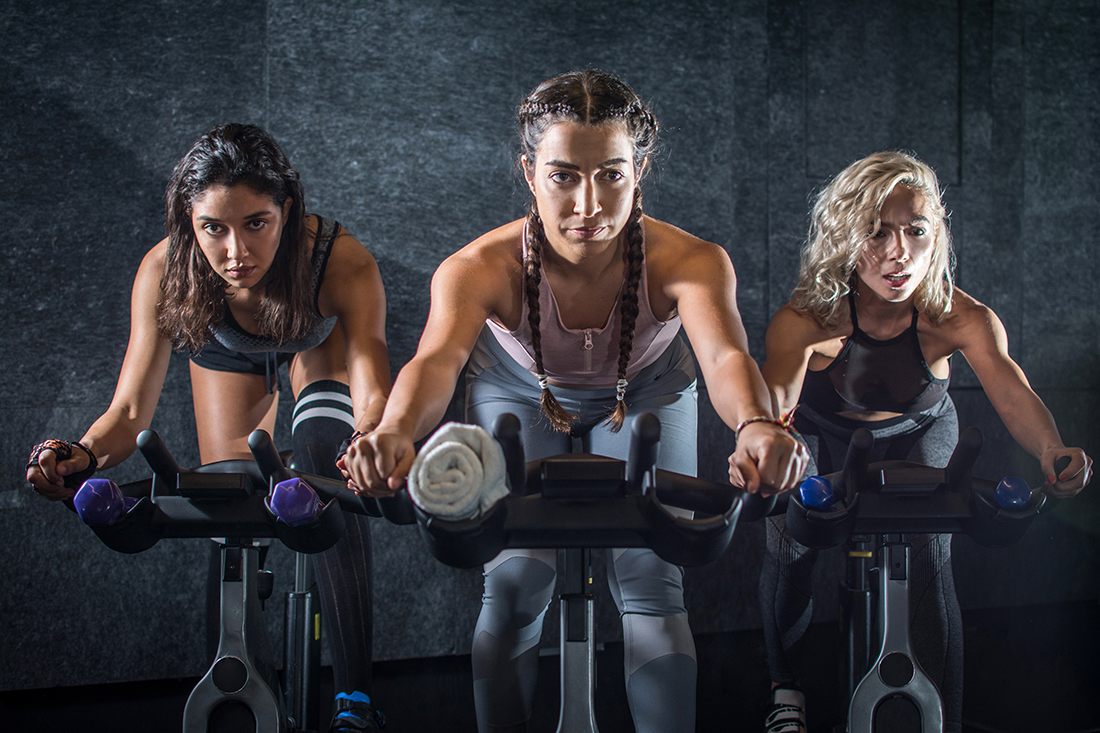
This phase starts on the first day of your period and ends when you ovulate. This phase is on average 16 days. During this phase, your body releases follicle-stimulating hormone, which, as the name suggests, stimulates the ovaries to produce follicles, small sacs that contain an immature egg. Estrogen starts to rise after your period, so take advantage of its anabolic properties and go make some strength gains!
As you start to regain your energy, you’ll also enjoy better recovery and a higher pain threshold. Feel free to do more intense cardio, HIIT and yoga practices, and train more regularly. You may find yourself having better endurance around this time, so you may feel more inspired to train for that marathon! You’ll be feeling fresh and open to trying new things, so it can be a good time to try a new class or start a new routine. This phase is the best time to eat those delicious carbohydrates, as rising estrogen helps with insulin sensitivity – Extra sweet potato fries anyone?
One thing to be aware of, some have attributed higher estrogen to higher injury risk. This is because some studies looking at knee laxity in exercising women suggested an increased risk of injury, but this is still unclear in the literature. Do the obvious thing – if you have sore knees, warming up properly is even more crucial during this time, and lay off heavy or repetitive movements that are hurting your joints.
Ovulatory phase:
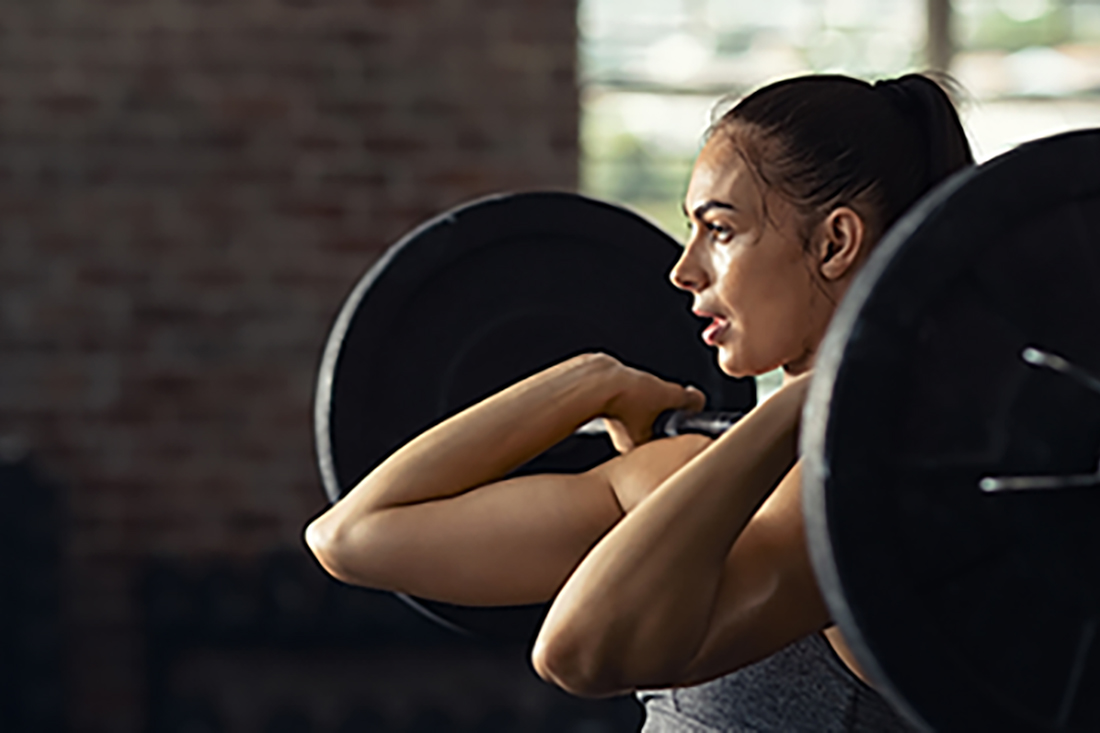
This is midway through your cycle and lasts approximately 24 hours. Your brain gets a signal to then dramatically increase the luteinizing hormone (LH), which then causes ovulation, the release of the egg to the ovary. Testosterone and estrogen peaks here, so you have the energy to crush your workouts with new levels of power and strength!
Go for that PB (personal best), smash those goals and aim for the stars!
Luteal phase:
The luteal phase usually lasts between 12-14 days. The main hormone associated here is Progesterone, which is released by the corpus luteum (a temporary structure formed from the follicle that had the maturing egg).
This stimulates the thyroid; your body temperature increases and your metabolic expenditure can be higher around this time (yay!).
In the first half of this phase, estrogen rises for the second time and you still have plenty of energy so you can focus on strength training and other intense types of exercise. Inflammation should be lower here and immunity strong, so feel free to get extra sweaty! Evidence suggests that after the first few days here, exercise performance is worsened during the mid-luteal time as compared to the mid-follicular phase, so you may want to start winding things down in preparation for menstruation.
Progesterone peaks midway through and then starts to come back down, along with Estrogen. These two hormonal drops can play a role in PMS symptoms (not so yay). You might be feeling moody and irritable, somehow everyone (especially your significant other) is just that much more annoying right now. A lot of women struggle with feelings of anxiety and self-depreciation during this stage, so if this is you, cut yourself some slack and give your body some love! Meditate, take a hot bath, bring out the essential oils, do what you need to make yourself feel good. You may also experience more bloating, water retention and breast pain or tenderness during this time. Prioritise anti-inflammatory foods, cut back on the sodium and support your body with whole foods as always. Your body will be using more fat as fuel here, so if you were thinking of going low carb, may as well ride with this hormonal wave!
Menstrual Phase:
This is part of the Follicular phase and approximately days 1 – 6 of your cycle, from the day that you start bleeding. If there is no pregnancy, the corpus luteum that developed in the last phase shrinks and dissolves, and voila, your lovely period awaits you. You may experience tiredness, fatigue, moodiness due to the drop in progesterone and estrogen (perhaps pesky hormonal acne too as testosterone is higher relatively). Many women find this is the time of the month they feel most drawn inwards, reflective and in need of comfort.
This is a great time to focus on gentle activities like restorative yoga, sliding into a nourishing, longer savasana afterwards. Try simple walking, or just giving yourself a (real) break for once! If you are weight training regularly, this can be a perfect time to deload.
Remember that women are all affected differently by their period. Always listen to your body – if you feel energetic, then go for it! Lower estrogen at this time may mean that you’re less prone to injuries. Your metabolic rate also decreases here and falls to its lowest point one week before ovulation. If you still want to train but feel like your energy is not quite there, you can go lighter on the weights, work on your form, and develop your skill for the mind to muscle connection.
Final Thoughts:
Should you try cycle syncing? So far, results are mainly anecdotal, so science has some catching up to do. This method is just trying to get you to pay attention to how your body and mind feel, and ‘go with the flow’. By training and eating following energy levels, mood and natural changes in hormones, you can let go of always needing to ‘go go go’ and still see the results you want (or even better results!).
Whether you see validity in being in tune with your menstrual cycle or not, you can choose how far you go with it. Just know that you don’t always have to go hard at the gym every single day to see results. More pain doesn’t always mean more gain! By working in line with your natural rhythms, you can glide towards your body composition goals a little more smoothly. Give it a try when your next cycle starts and see how it works for you!
- Belanger MJ, Moore DC, Crisco JJ, Fadale PD, Hulstyn MJ, Ehrlich MG. Knee Laxity Does Not Vary with the Menstrual Cycle, before or after Exercise. The American Journal of Sports Medicine. 2004;32(5):1150-1157. doi:10.1177/0363546503261360
- Bunt JC. Metabolic actions of estradiol: significance for acute and chronic exercise responses. Med Sci Sports Exerc. 1990;22(3):286-290.
- Bruinvels G, Burden RJ, McGregor AJ, et al. Sport, exercise and the menstrual cycle: where is the research? British Journal of Sports Medicine 2017;51:487-488.
- Chidi-Ogbolu N, Baar K. Effect of Estrogen on Musculoskeletal Performance and Injury Risk. Front Physiol. 2019;9:1834. Published 2019 Jan 15. doi:10.3389/fphys.2018.01834
- de Jonge, X.A.K.J. Effects of the Menstrual Cycle on Exercise Performance. Sports Med 33, 833–851 (2003). https://doi.org/10.2165/00007256-200333110-00004
- Freemas, Jessica A.1; Baranauskas, Marissa N1; Constantini, Keren2; Constantini, Naama3; Greenshields, Joel T.1; Mickleborough, Timothy D.1; Raglin, John S.1; Schlader, Zachary J.1 Exercise Performance Is Impaired during the Mid-Luteal Phase of the Menstrual Cycle, Medicine & Science in Sports & Exercise: July 15, 2020 - Volume Publish Ahead of Print - Issue - doi: 10.1249/MSS.0000000000002464
- Ikeda K, Horie-Inoue K, Inoue S. Functions of estrogen and estrogen receptor signaling on skeletal muscle. J Steroid Biochem Mol Biol. 2019;191:105375. doi:10.1016/j.jsbmb.2019.105375
- Joo, M.H., Maehata, E., Adachi, T. et al. The relationship between exercise-induced oxidative stress and the menstrual cycle. Eur J Appl Physiol 93, 82–86 (2004). https://doi.org/10.1007/s00421-004-1168-4
- Journals.physiology.org. 2020. Effect Of Menstrual Cycle Phase On Carbohydrate Supplementation During Prolonged Exercise To Fatigue | Journal Of Applied Physiology. [online] Available at:
- Nina RW Geiker, Christian Ritz, Sue D Pedersen, Thomas M Larsen, James O Hill, Arne Astrup, A weight-loss program adapted to the menstrual cycle increases weight loss in healthy, overweight, premenopausal women: a 6-mo randomized controlled trial, The American Journal of Clinical Nutrition, Volume 104, Issue 1, July 2016, Pages 15–20, https://doi.org/10.3945/ajcn.115.126565
- Oosthuyse, T., Bosch, A.N. The Effect of the Menstrual Cycle on Exercise Metabolism. Sports Med 40, 207–227 (2010). https://doi.org/10.2165/11317090-000000000-00000
- Reed BG, Carr BR. The Normal Menstrual Cycle and the Control of Ovulation. [Updated 2018 Aug 5]. In: Feingold KR, Anawalt B, Boyce A, et al., editors. Endotext [Internet]. South Dartmouth (MA): MDText.com, Inc.; 2000-. Available from: https://www.ncbi.nlm.nih.gov/books/NBK279054/
- Solomon, S. J., Kurzer, M. S., & Calloway, D. H. (1982). Menstrual cycle and basal metabolic rate in women. American Journal of Clinical Nutrition, 36(4), 611-616.
- Vaiksaar, S., Jürimäe, J., Mäestu, J. et al. No effect of menstrual cycle phase on fuel oxidation during exercise in rowers. Eur J Appl Physiol 111, 1027–1034 (2011). https://doi.org/10.1007/s00421-010-1730-1
More Fit Talk

Take your training up a notch with these game-changing gym accessories! Your gym bag will have everything you need to smash a killer workout.
July 8, 2025

Is this gloomy weather crushing your motivation to train? We've got you! Here are 5 hacks that will have you excited to exercises in the cold winter months.
June 17, 2024

We all know returning to the gym after time off can be no easy feat. Let's look at some solutions so you can get back on track with your workouts.
February 29, 2024

Whether you’re looking for a yoga class that will help with your flexibility or with strength, there are many yoga practices to choose from.
February 1, 2024

Unsure whether or not to try HIIT? This style of training is super popular amongst the fitness community, but is it really as good as they say it is? Let's find out!
January 2, 2024