The Supp Showdown: Fat Burners vs. Pre-Workouts

06
Jan
The Supp Showdown: Fat Burners vs. Pre-Workouts
Reading time - 9 mins
Walk into any supp store, and you are immediately bombarded by all types of supplements offering explosive energy, skin-splitting pumps, and rapid fat loss. Pre-workouts and fat burners are the two categories that dominate the shelves.1
Often, these products share similar ingredients (like caffeine), but are they the same thing? Can I swap one for the other?
The short answer is no. While they have overlapping ingredients, their mechanisms of action and primary goals are fundamentally different.
Let’s cut through the hype and utilise scientific research to explain the real differences, benefits, and common myths surrounding fat burners and pre-workouts.
What is a Pre-Workout?
A pre-workout supplement is designed for acute, immediate use. You take it 20–30 minutes before training to enhance the quality of that specific session.
The Goal: To maximise performance, increase focus, delay fatigue, and improve blood flow (the "pump") during exercise.
Key Research-Backed Ingredients & Benefits:
- Caffeine (Energy & Focus): The cornerstone of most pre-workouts. It acts as an adenosine receptor antagonist in the brain, reducing the perception of effort and increasing alertness.2 Research: Extensive meta-analyses confirm caffeine acts as an ergogenic aid, improving muscular endurance, muscular strength, and anaerobic power.
- Beta-Alanine (Endurance): This non-essential amino acid increases muscle carnosine levels.3 Carnosine buffers acidity in muscle tissue during high-intensity exercise.4 Research: Studies show beta-alanine supplementation can improve performance in high-intensity exercise bouts lasting one to four minutes (like HIIT or high-rep lifting). Note: This ingredient causes the infamous "tingles" or paresthesia.5
- L-Citrulline/Citrulline Malate (Blood Flow): A precursor to L-arginine, which increases nitric oxide production. This dilates blood vessels (vasodilation), improving oxygen delivery to muscles and creating a stronger "pump."6 Research: Citrulline malate has been shown to enhance muscle endurance and reduce soreness after exercise.7
What is a Fat Burner? (The Metabolic Support)
A "fat burner" (thermogenic) is designed to support weight loss efforts over a longer period. Unlike a pre-workout intended for a single hour of activity, fat burners aim to subtly alter your metabolism throughout the day.
The Goal: To modestly increase resting metabolic rate (thermogenesis), increase fat oxidation (using fat for fuel), and often, suppress appetite to help maintain a caloric deficit.
Key Research-Backed Ingredients & Benefits:
- Caffeine (Thermogenesis): Yes, caffeine again. In this context, it is used to stimulate the central nervous system, increasing energy expenditure (calorie burning) and promoting lipolysis (breaking down fat cells) .8 Research: Studies indicate that caffeine can increase the resting metabolic rate by 3-11%, with larger doses having a greater effect.9
- Green Tea Extract / EGCG (Fat Oxidation): Rich in catechins, specifically EGCG.10 These compounds can inhibit an enzyme that breaks down norepinephrine, prolonging the signal for fat cells to break down fat. Research: A meta-analysis found that green tea catechins, when combined with caffeine, significantly increased energy expenditure and fat oxidation compared to caffeine alone.11
- Capsaicinoids (Heat Production): Derived from chilli peppers, these compounds activate brown adipose tissue (BAT), which burns calories to generate heat. Research: Evidence suggests capsaicinoids can modestly increase energy expenditure and increase lipid (fat) oxidation. 12
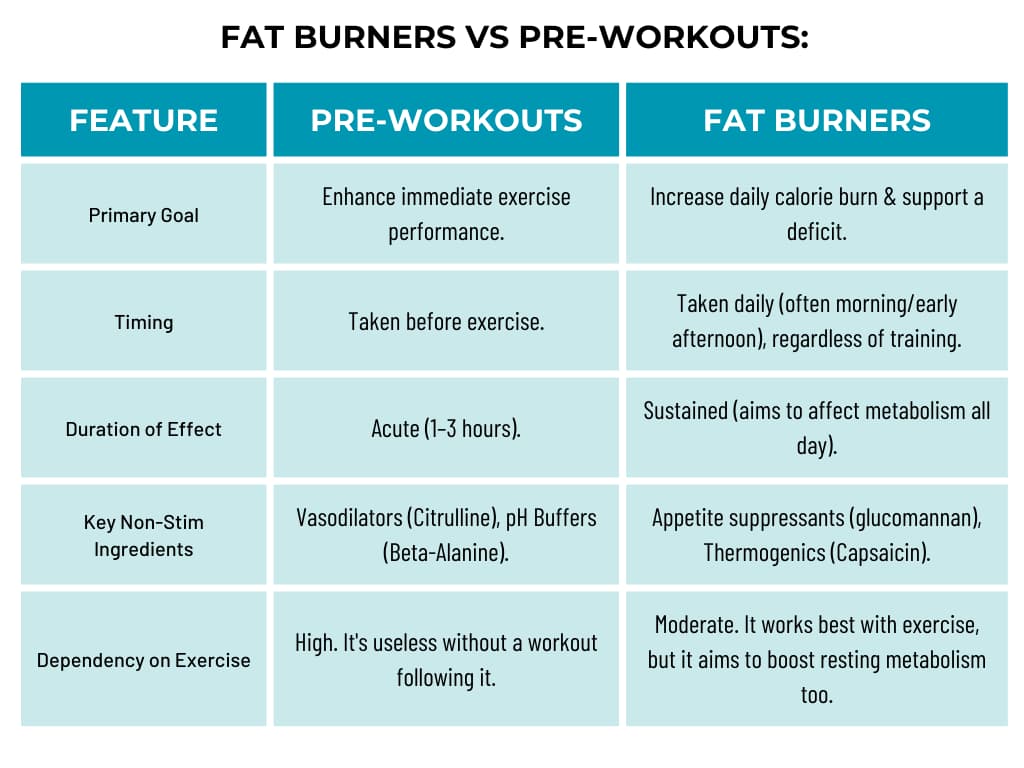
The Main Differences:
While both contain stimulants, their design philosophy are different.
Myths Busted
Pre-Workouts
Myth 1: The "tingles" mean it's working and you're building muscle.
- Reality: The tingling sensation (paresthesia) is purely a side effect of a high dose of Beta-Alanine triggering nerve endings under the skin.13 It is harmless, but the sensation itself doesn't mean you are getting a better workout or building more muscle in that moment; it just means the ingredient is present.
Myth 3: More scoops equal a better workout.
- Reality: Stimulants have a diminishing point of return. Doubling a dose of caffeine won't double your performance, but it will significantly increase your risk of anxiety, jitteriness, and a massive mid-workout crash that ruins your session.
Fat Burners
Myth 1: Fat burners actually "burn" fat off your body.
- Reality: No pill dissolves fat. Fat burners work by slightly increasing your body's temperature (thermogenesis), causing you to burn a few extra calories—perhaps an extra 50–100 a day. To lose one pound of fat, you need a roughly 3,500-calorie deficit.14 A fat burner might contribute 3% to the effort; your diet contributes the other 97%.
Myth 2: Fat burners target belly fat.
- Reality: Spot reduction is a physiological impossibility. You cannot take a supplement (or do a specific exercise) to target fat loss in one area. Your genetics determine where your body stores and mobilises fat from.15
Frequently Asked Questions
Q1: Can I take a pre-workout and a fat burner on the same day?
A: Proceed with extreme caution. Both usually contain high amounts of caffeine. If your fat burner has 200mg of caffeine and your pre-workout has 300mg, you are hitting 500mg in a short window, which is well above the recommended daily safe limit for most adults (around 400mg). If you must use both, use a stimulant-free pre-workout or a stimulant-free fat burner.
Q2: Do I need to cycle off these supplements?
A: Yes. Your body develops a tolerance to caffeine and other stimulants very quickly. After 4–6 weeks of continuous use, you will likely find you need a higher dose to feel the same effects. It is highly recommended to take a 1–2 week "stimulant break" every month or two to reset your adenosine receptors.
Q3: Which one should I prioritise buying if I'm on a budget?
A: Generally speaking, a pre-workout offers more tangible benefits. The ability to train harder and longer leads to better muscle retention and calorie burn during exercise. The metabolic boost from fat burners is often negligible compared to simply eating one fewer snack per day. Prioritise real food, then perhaps a pre-workout if you need an energy boost for training.
Scientific References
Source: Guest, N. S., et al. (2021). "International society of sports nutrition position stand: caffeine and exercise performance." Journal of the International Society of Sports Nutrition.
Source: Trexler, E. T., et al. (2015). "International society of sports nutrition conference and transmission: Beta-alanine." Journal of the International Society of Sports Nutrition.
Source: Pérez-Guisado, J., & Jakeman, P. M. (2010). "Citrulline malate enhances athletic anaerobic performance and relieves muscle soreness." Journal of Strength and Conditioning Research.
Source: Dulloo, A. G., et al. (1989). "Normal caffeine consumption: influence on thermogenesis and daily energy expenditure in lean and postobese human volunteers." The American Journal of Clinical Nutrition.
Source: Hursel, R., et al. (2009). "The effects of green tea on weight loss and weight maintenance: a meta-analysis." International Journal of Obesity.
Source: Whiting, S., et al. (2012). "Capsaicinoids and weight management: a meta-analysis of lean body mass and energy expenditure." Appetite.
More Fit Talk

Not sure which Applied Nutrition protein to grab? We break down Iso Clear vs Critical Whey so you can pick with confidence.
September 2, 2026
Your September shred stack sorted: protein, fat burners, aminos and recovery picks built to get you lean, fast.
August 23, 2026
This top 5 protein powders help you hit your goals faster. From low-calorie blends to metabolism-boosting formulas, these proteins are built to keep you fuller for longer, crush cravings, and preserve lean muscle mass while you shred.
August 22, 2026
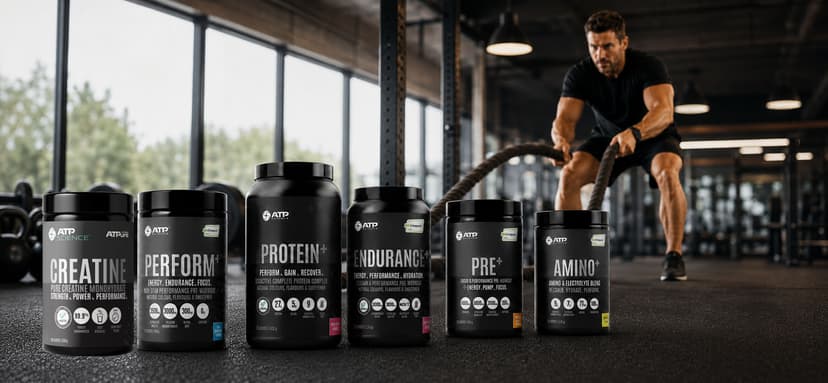
Pre+, Endurance+, Perform+ or Protein+? Here's exactly which ATP Science Performance Plus stack matches your training goals.
August 11, 2026

Build a practical ATP Science supplement routine to support energy, hydration, strength, performance and recovery throughout your active week.
July 31, 2026